I in no way condone insulting anyone based on where they are from or their ethnicity. That sort of behavior is reprehensible and uncalled for. But... if you ever find yourself in a heated argument with a Southerner, may I, suggest, you might call them... a Waffle House motherfucker!
Just keep that one in your back pocket if you ever need it.
Monday, March 30, 2009


Friday, March 27, 2009
GRANT PARK


I’ll keep it short, but Grant Park has a decent amount of history. It’s named after Lemuel P. Grant, not Ulysses S. Grant, which wouldn’t make any sense if you think about it. Lemuel was on the other side of the war and was in charge of constructing defensive lines around the city. The high part of the park, near where my house is, was a lookout spot called

There are three major attractions in Grant Park: the zoo, which has some giant pandas, Xi Lan, Mei Lan, Lun Lun, and Yang Yang, the Cyclorama, and the

I’m not into zoos (animals in cages of any sort doesn’t do it for me), so I haven’t been there, but that’s the park’s main draw, along with the usual jogging, strolling with babies and massive family barbecues.

Next door to the zoo is an odd attraction, the Cyclorama, a circular painting (the largest oil painting in the world) that depicts the Battle of Atlanta in the Civil War. There are dioramas in front of the painting that create an optical illusion where you can’t tell where the dioramas (horses, soldiers, etc.) and painting start and end. But is this something that you really need to see? I can’t say that it is, unless you particularly fancy Civil War kitsch.

No photography allowed in the Cyclorama, but this photo of a painting in the adjacent mini-museum gives you the basic idea

The


 Across the street is the popular seafood restaurant Six Feet Under, named with the graveyard in mind, and Ria’s Bluebird, Grant Park’s best breakfast/lunch, ultra-hipster spot. There are about eight restaurants in Grant Park, mostly at the northern end of the neighborhood.

It snows once in a while (not very often)
If there is one criticism I have of Grant Park, it’s that there is a lack of commercial property considering how many people live here. In the whole neighborhood, I believe there are two gas stations, one bedraggled 24-hour pharmacy and just a few corner markets, no supermarket. This is hardly a big deal, though. It’s only 10 minutes to

Spring in the park
There’s also a lot of small, neat-looking historical properties around the neighborhood that used to be small grocery stores, but are now unused. They are almost all on side streets and it would be great if they were actual stores and businesses, but more likely, I can see them being converted into small gallery spaces (there is one new, small gallery space on Boulevard).

Open your business here
Some things I’d like to see in the neighborhood: an authentic taqueria, a store that sells Victorian antiques and some antique stores in general (it’s amazing that there isn’t one in a neighborhood that has so much old stuff), a thrift store, a bank with an ATM, a bookstore (I can keep dreaming), some vintage/junk/whatever stores, and a supermarket on the edge of the neighborhood (preferably a Trader Joe’s, Whole Foods or a local Farmer’s Market type store). Some ethnic grocery stores would also be swell, but I think there would have to be some Latinos or Asians in the area for that to happen.

This is my favorite house in the neighborhood, the Burns Mansion. It is often part of the Grant Park Tour of Homes. Three gay fellas live in there and have restored the interior to perfect, Victorian splendor with some amazing themed rooms (sorry, don't have any photos of the interior).
 This is another mansion in Grant Park owned by a gay couple. They have a spectacular backyard.
 This looks like it was formerly a store with a house attached to it


 A lot of stained glass in Grant Park
 This is a modern Victorian across the street from the Burns Mansion. I believe it was built in the last ten years. Fooled me.
 This used to be a Masonic Lodge, now a restaurant and real estate agency.
 A lot of babies in Grant Park
 This is supposed to be converted into a B&B. But restoration looks like it may have been stalled.


This is my house

 The parlor


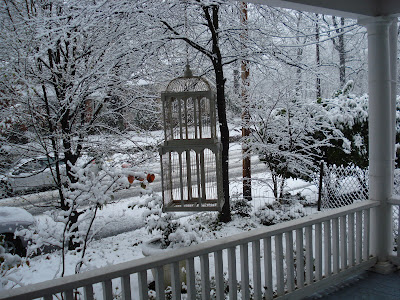 This is the porch after it snowed
 This is another mansion in Grant Park owned by a gay couple. They have a spectacular backyard.
 This looks like it was formerly a store with a house attached to it


 A lot of stained glass in Grant Park
 This is a modern Victorian across the street from the Burns Mansion. I believe it was built in the last ten years. Fooled me.
 This used to be a Masonic Lodge, now a restaurant and real estate agency.
 A lot of babies in Grant Park
 This is supposed to be converted into a B&B. But restoration looks like it may have been stalled.


This is my house

 The parlor


 This is the porch after it snowed
Friday, March 13, 2009
CALIFORNIA DREAMING
Much like a New Yorker who moves to L.A. and complains that there is no snow and no proper seasons and that people are shallow and dress like bums, I am forever a transplanted Angeleno hundreds of miles away from my homeland, lacking sunshine at times and ocean breezes and not truly adapting to the relaxed pace of things.
I haven’t managed to get beyond my narrow Angeleno point of view despite ordering sweet tea with just about any meal and attempting to drive like I don’t care where I’m going or when I get there.
One thing that I can’t get used to in
Here in
When I get hungry and I’m driving in downtown
Another petty gripe that I have is that there is no ocean here in
It’s not right to complain about the weather in
There are some lakes beyond the suburbs of
I know people live in really shitty places like
Tuesday, March 10, 2009
SIGNS OF THE SOUTH II

I love the Hot Dog King (But his kingdom is dwindling)
Greenville, S.C.
 Um, no thanks. I think I will shop somewhere else.
 Grandpa Store: Gizzar $3.99
 Fresh Meat Skin, North Georgia
 North Georgia Cheap Grub, Chicken Biscuit $1.25
 Kreeze Bings (?) apparently available at the Northside Tavern, Atlanta
 Pass me dem tax forms mon
 The Hair Shack Dawsonville, GA
 Denture Repair, Decatur, GA
 Bo-Nats 7-11, Greenville, SC
 Beefalo in North Georgia
 Jesus is Mr. Popular
Tuesday, February 24, 2009
CHICO & CHANG

I don’t know why I became determined to eat at the grubby looking takeout place called Chico & Chang on Ponce de Leon. I guess I hoped that it was Mexicans who had come to appreciate Asian food (there are often a lot of Mexicans working in Chinese restaurant kitchens), though it was much more likely to be Chinese people making Mexican food, as Chinese folks own numerous little takeout places in the area, where they specialize in wings and burgers. When I came up to the takeout window, there was a Chinese lady who told me that my car was facing the wrong direction. As I drove around the place, there were signs that I should back out while I still had the chance. I ignored the dead guy sprawled out in the parking lot clutching a fortune cookie, as well as the scent of steamed broccoli waiting to be added to Mexican dishes like burritos and fajitas. Though I had hoped for Mexican food, I played it safe and ordered cold sesame noodles, a dish that is only occasionally found on Chinese menus. The lady warned me that the sauce came on the side, which just didn’t sound right. As I waited 25 minutes or so for my food, I scanned Chico & Chang’s expansive menu, which includes a fajita chicken sub, bbq burger, stuffed jalapenos, their “famous” chili, as well as two “exclusive” East meets West dishes, the moo shu chicken burrito and the Mongolian beef sub. The wrongest sounding thing on the menu is the veggie chimichanga with broccoli, mushrooms, bell peppers and onions. The sesame noodles turned out to be vegetable lo mein with a container of sesame sauce. Possessing an iron-clad stomach, I ate it anyways. It was bad, but I have eaten worse things in places like Tunisia and North Dakota. Afterwards, though, a sick feeling lingered in my stomach for hours. My advice to Chico & Chang: Chang, don’t try and be Chico. I have cooked plenty of crummy Chinese food in my time. My wife even refuses to allow me to cook my “famous” curry noodles ever again. You, Chang, make Chinese food in a wrong way that Chinese people would shake their heads at. I do not want to consider what your Mexican food is like. In fact, I won’t. Blechh! Yuck. I did.
Thursday, February 5, 2009
THE HILLS BEYOND
One of America’s great novelists, Thomas Wolfe didn’t live past his thirties, but in his short life completed two voluminous novels, while two other bulky classics were released posthumously. These four books, Look Homeward Angel, Of Time and the River, The Web and the Rock and You Can’t Go Home Again comprise the story of Wolfe’s life from growing up in the South as the youngest in a very large and eccentric family to going to Harvard to study playwriting to becoming a bitter English teacher at NYU and then an acclaimed author to traveling through Germany just as the Nazis were beginning to rise to famously going back to his hometown, which he had painted a little bit too close to the truth in Look Homeward Angel. Somehow, Wolfe’s writing has fallen out of the canon of essential American literature. But his work, classically American and distinctly Southern, is as lively and inspired as that of any great writer.
Wolfe’s parents are the two characters that loom over all others in his novels. His father, William Oliver Wolfe (Oliver Gant in Wolfe’s books), carved gravestones and was a heavy drinker. The character that is Wolfe in his first two books, Eugene Gant, is obsessed with his father’s giant stonecutter’s hands. His mother, Julie E. Wolfe (Eliza Gant in Wolfe’s books), abandoned her husband and somewhat the rest of the family to run a busy boarding house. Julie got caught up in the rampant real estate speculation that took hold of Wolfe’s hometown, Asheville, North Carolina (called Altamont and later Libya Hill in Wolfe’s books), in the early part of the last century as it transformed from an isolated Southern town into a popular mountain resort.

A little over a year ago, we happened to be in Asheville during the Thomas Wolfe Festival. We caught one event, a tour of where the Will Harris murders took place. An elderly man in dramatic detail discussed every imaginable aspect of the murders and where they took place in Asheville. The 1906 murders were the inspiration for Wolfe’s short story Child by Tiger, also part of The Web and the Rock. We also toured Julia Wolfe’s former boarding house, where Wolfe partially grew up, which is a beautiful Victorian with all original furnishings.
Asheville is a very attractive town in a beautiful, Appalachian setting. The Blue Ridge Parkway skims by. There are several attractive Art Deco buildings and others that date back to Wolfe’s time. There’s a great bookstore, Malaprop’s Bookstore/Café, which has many Wolfe-related books, as does the former boarding house, now called The Thomas Wolfe Memorial. However, the town has little relation to the one Wolfe describes in his books. That place, small town, segregated, loaded with all sorts of odd types, surrounded by forests and with the not so distant memory of beaten Confederate soldiers marching through it exists for the most part only in Wolfe’s books.

Wolfe’s memories of his youth were exceptionally vivid in his writing. Here is a selection from The Web and the Rock, where Wolfe (in this book and You Can’t Go Home Again, the Wolfe character is named George Webber) is visited every day at 3 o’clock by a group of black boys on bicycles who do tricks for him and call him Paul.
He heard them coming from afar, he heard them racing down the street, he heard the furious thrum of all their flashing wheels, and then they flashed before him, they were there! They shot past, eight abreast, bent over, pedaling like black demons; they shot past on their flashing wheels, the fibrous market baskets rattling lightly; and as they flashed before him, they cried “Paul!”
Then, wheeling solemnly in squadrons, they rode slowly, gravely back, and wheeled and faced him, steady and moveless on their wheels, and said, “Hi, Paul! … How’s old Paul today!”
Then the parade began. They did amazing things, performed astounding evolutions on their wheels; they flashed by in fours and then by twos; they did squads-right, retreated or advanced in echelon, swooped past in single file like soaring birds, rode like demons soaring in the wind.
Then madness seized them, and desire for individual excellence, a lust for championship, wild inventiveness, whimsical caprice. They shouted with rich nigger laughter, howled derisory comments at their fellows, strove to outdo one another—to win applause and approbation—all for Paul! They swooped down the street with lightlike swiftness and a bullet speed; they swooped down in terrific spirals, snaking from one side to the other, missing curbs by hair-line fractions of an inch; they shot past, stooping like a cowboy from the saddle, and snatching up their ragged caps as they shot past. They shouted out to one another things like these:
“Outa my way, old Liver Lips! I got somethin’ dat I got to show to Paul!”
“Hey, Paul—look at ole Slewfoot ride dat wheel!”
“Move ovah deh, M’lasses! Let ole Paul look at someone who can ride!”
“Get outa my way, Big Niggah, ‘fo I rides all ovah you! I’m goin’ to show Paul somethin’ dat he nevah saw befo’!—How’s dis one, Paul?”
And so they soared and swooped and flashed, their rich black voices calling back to him, their warm good voices bubbling with black laughter, crying, “Paul!”
And then they were off like furies riding for town and the reopening of the markets, and their rich, warm voices howled back to him with affectionate farewell:
“Good-bye, Paul!”
“So long, Paul,”
“We’ll be seein’ you, Paul!”
“My name,” he shouted after them, “is George Josiah Webber!”
Flashed and rose the splendid name as proud and shining as the day.
And answered faintly, warm with pleasant mockery, upon the wind:
“Yo’ name is Paul! Paul! Paul!”
And coming faintly, sadly, haunting as a dream:
“—is Paul! Paul! Paul!”
Thomas Wolfe coming from the place that he did during the time that he did was apt to dated stereotypes. There is an awful scene in Of Time and the River, where the Wolfe character, Eugene Gant, arrested, along with a group of friends, for driving like drunken madmen through small South Carolina towns, is being tossed into a jail cell with a black man and protests with extreme violence. The scene is drawn in such detail that it seems like something that may have actually happened to Wolfe. While Wolfe has black and Jewish characters in his books which are complex and sympathetic (especially Esther Jack, in real life, Aline Bernstein, the love of his short life, who was Jewish), he does often go to great ends describing all minorities with very offensive imagery. For instance, he uses the term “beak-nosed Jew” incessantly and if an Italian or Irishman shows up in his writing, they will surely be speaking poor English or falling down drunk. Though, it’s often these characters that become his closest friends. The directness of Wolfe’s racist descriptions gives the reader a very good idea of what the attitude of the time was like, but it takes nothing away from his writing.
Wolfe is particularly fabulous with dialogue. Various old-timey characters show up in his novels and make incredibly lasting and often negative impressions by blabbing on about this or that. The dialogue of his family is especially rich. Here’s a selection from the very beginning of Of Time and the River. Eugene Gant is waiting at the train station with his mom and sister, who have come to see him off to Harvard.
“Well, boy,” she was now saying gravely, “you are going—as the sayin’ goes—“ here she shook her head slightly, strongly, rapidly with powerful puckered lips and instantly her weak worn eyes of brown were wet with tears “—as the sayin’ goes—to a strange land—a stranger among strange people.—It may be a long long time,” she whispered in an old husky tone, her eyes tear-wet as she shook her head mysteriously with a brave pathetic smile that suddenly filled the boy with rending pity, anguish of the soul, and a choking sense of exasperation and of woman’s unfairness “—I hope we are all here when you come back again… I hope you find us all alive...” She smiled bravely, mysteriously, tearfully. “You never know,” she whispered, “you never know.”
“Mama,” he could hear his voice sound hoarsely and remotely in his throat, choked with anguish and exasperation at her easy fluency of sorrow, “—Mama—in Christ’s name! Why do you have to act like this every time some one goes away! I beg of you, for God’s sake, not to do it!”
“Oh, stop it! Stop it!” his sister said in a rough, peremptory and yet kindly tone to the mother, her eyes grave and troubled, but with a faint rough smile about the edges of her generous mouth. “He’s not going away forever! Why, good heavens, you act as if some one is dead! Boston’s not so far away you’ll never see him again! The trains are running every day, you know… Besides,” she said abruptly and with an assurance that infuriated the boy, “he’s not going today, anyway. Why, you haven’t any intention of going today, you know you haven’t,” she said to him. “He’s been fooling you all along,” she now said, turning to the mother with an air of maddening assurance. “He has no idea of taking that train. He’s going to wait over until tomorrow. I’ve known it all along.”
The boy went stamping away from them up the platform, and then came stamping back at them while the other people on the platform grinned and stared.
“Helen, in God’s name!” he croaked frantically. “Why do you start that when I’m all packed up and waiting here at the God-damned station for the train! You know I’m going away today!” he yelled, with a sudden sick desperate terror in his heart as he thought that something might now come in the way of going. “You know I am! Why did we come here? What in Christ’s name are we waiting for if you don’t think I’m going?”
The young woman laughed her high, husky laugh which was almost deliberately irritating and derisive—“Hi! Hi! Hi! Hi! Hi!”—and prodded him in the ribs with her large stiff fingers. Then, almost wearily, she turned away, plucking at her large chin absently, and said: “Well, have it your own way! It’s your own funeral! If you’re determined to go today, no one can stop you. But I don’t see why you can’t just as well wait over will tomorrow.”
“Why, yes!” the mother now said briskly and confidently. “That’s exactly what I’d do if I were you! ... Now, it’s not going to do a bit of harm to any one if you’re a day or so late in getting’ there …Now I’ve never been there myself,” she went on in her tone of tranquil sarcasm, “but I’ve always heard that Harvard University was a good big sort of place—and I’ll bet you’ll find,” the mother now said gravely, with a strong slow nod of conviction—“I’ll bet you’ll find they haven’t moved a foot,” she said, “and let me tell you something, boy,” she now continued, looking at him almost sternly, but with the ghost of a smile about her powerful and delicate mouth “—now I haven’t had your education and I reckon I don’t know as much about universities as you do—but I’ve never head of one yet that would run a feller away for bein’ a day late as long as he’s got money enough to pay his tuition… Now she said slowly and powerfully. “You don’t have to worry about that—they’ll be glad to see you, and they’ll take you in a hurry when they see you’ve got the price.”
“No, Mama,” he said in a quiet frenzied tone, “I beg of you, for God’s sake, please, not to—“
“All right, all right,” the mother answered hastily in a placating tone, “I was only sayin’—“
“If you will kindly, please, for God’s sake—“
Wolfe’s four novels are best read in order, though the first two have more to do with each other than the last two have to do with the first two. Each is between 600 and 900 pages. In my opinion, Look Homeward Angel, Of Time and the River and You Can’t Go Home Again are exemplary masterpieces. The Web and the Rock has some great moments and several fantastic stories, but the long passages of arguing between George Webber and Esther Jack are exasperating. Both The Web and the Rock and You Can’t Go Home Again were compiled from a large manuscript left at Wolfe’s death by his editor at the time, Edward C. Aswell, who did a superb job. You Can’t Go Home Again is less from the perspective of its protagonist than the other three books. Its focus changes from chapter to chapter and includes some of his most clever sketches of various odd characters such as Frederick Jack, the rich husband of Esther Jack, with whom Webber (Wolfe) had a long affair with, and his imaginary editor, Foxhall Edwards, who in the book has a memorable breakfast of canned fruit salad.
Wolfe also wrote numerous short stories, which were released in several volumes. Many of these are very much in the tradition of classic Southern tales. But generally Wolfe was long-winded and many of his lengthy tangents seem to spiral in every which direction like freeform dreams. His books rarely have any sort of plot. His characters are so real and vibrant that they don’t really need to do much of anything except comment on the weather or gossip about other townsfolk. When family members pass away in Wolfe’s novels, the description of sickness and mourning are unsentimental and have a neo-realistic quality. The loss of his brother, Luke, in Look Homeward Angel and his father in Of Time and the River appear to be described exactly as these events took place in real life with each individual family member reacting to the loss in their own individual manner.
Other than the South, which Wolfe portrays exquisitely, his novels are also set in Boston, New York, Germany, France and England. In these places where Wolfe spent time, the Eugene Gant or George Weber character meets an eminent oddball author who has championed his work, falls in love several times, but rarely has a real relationship with anyone, samples the world’s food, drink and whores, finds out while in France that his best friend is gay and that the girl he is crazy about is in love with his gay friend and describes various street and café scenes with fabulous humor.
In 1931 Wolfe, already a noted author from his first book, began working on Of Time and the River, while living in Brooklyn. It’s one of several places that got under his skin and which he examines somewhat on the surface in the short story, Only the Dead Know Brooklyn, of which here’s an excerpt:
Dere’s no guy livin’ dat knows Brooklyn t’roo an’ t’roo, because it’d take a guy a lifetime just to find his way aroun’ duh f----- town.
So like I say, I’m waitin’ for my train t’ come when I sees dis big guy standin’ deh---dis is duh foist I eveh see of him. Well, he’s lookin’ wild, y’know, an’ I can see dat he’s had plenty, but still he’s holdin’ it; he talks good an’ is walkin’ straight enough. So den, dis big guy steps up to a little guy dat’s standin’ deh, an’ says, “How d’yuh get t’ Eighteent’ Avenoo an’ Sixty-sevent’ Street?” he says.
“Jesus! Yuh got me, chief,” duh little guy says to him. “I ain’t been heah long myself. Where is duh place?” he says. “Out in duh Flatbush section somewhere?”
“Nah,” duh big guy says. “It’s out in Bensonhoist. But I was neveh deh befoeh. How d’yuh get deh?”
“Jesus,” duh little guy says, scratchin’ his head, y’know—yuh could see duh little guy didn’t know his way about—“yuh got me, chief. I neveh hoid of it. Do any of youse guys know where it is?” he says to me.
“Sure,” I says. “It’s out in Bensonhoist. You take duh Fourt’ Avenoo express, get off at Fifty-nint’ Street, change to a Sea Beach local deh, get off at Eighteent’ Avenoo an’ Sixty-toid, an’ den walk down foeh blocks. Dat’s all yuh got to do,” I says.
“G’wan!” some wise guy dat I neveh seen befoeh pipes up. “Whatcha talkin’ about?” he says—oh, he was wise, y’know. “Duh guy is crazy! I tell you what yuh do,” he says to duh big guy. “Yuh change to duh West End line at Toity-sixt,” he tells him. “Get off at Noo Utrecht and Sixteent’ Avenoo,” he says. “Walk two blocks oveh, foeh blocks up,” he says, “an’ you’ll be right deh.” Oh, a wise guy, y’know.
“O yeah? I says. “Who told you so much?” He got me sore because he was so wise about it. “How long you been livin’ heah? I says.
“All my life,” he says. “I was bawn in Williamsboig,” he says. “An’ I can tell you t’ings about dis town you neveh hoid of,” he says.
“Yeah?” I says.
“Yeah,” he says.
“Well, den you can tell me t’ings about dis town dat nobody else has eveh hoid of, either. Maybe you make it all up yoehself at night,” I says, “befoeh you go to sleep—like cuttin’ out papeh dolls, or somp’n.”
“Oh, yeah?” he says. “You’re pretty wise, ain’t youh?”
“Oh, I don’t know,” I says. “Duh boids ain’t usin’ my head for Lincoln’s statue yet,” I says. “But I’m wise enough to know a phony when I see one.”
“Yeah?” he says. “A wise guy, huh? Well, you’re so wise dat someon’s goin’ t’bust yuh one right on duh snoot some day,” he says. “Dat’s how wise you are.”

Wolfe is big on repetition of phrases, whether in dialogue or in repeated descriptions. When he wants to emphasize a particular aspect of a character, he might mention how someone plucks at their chin or walks in a loping manner over and over. They might do these things in the course of a chapter more often than they ever could have in real life. It’s a part of the world that Thomas Wolfe creates in his writing that seems so authentic and at the same time just a little bit impossible and overstated.
In the brief period that he was alive, Wolfe left an enormous amount of eloquent work. He died of miliary tuberculosis at age 37 in 1938. We visited his grave at Riverside Cemetery in Asheville, where he is buried next to his parents. It’s a beautiful, hilly, wind-swept graveyard, as Southern as they come, and evocative of the life and times of Thomas Wolfe.

Wolfe’s parents are the two characters that loom over all others in his novels. His father, William Oliver Wolfe (Oliver Gant in Wolfe’s books), carved gravestones and was a heavy drinker. The character that is Wolfe in his first two books, Eugene Gant, is obsessed with his father’s giant stonecutter’s hands. His mother, Julie E. Wolfe (Eliza Gant in Wolfe’s books), abandoned her husband and somewhat the rest of the family to run a busy boarding house. Julie got caught up in the rampant real estate speculation that took hold of Wolfe’s hometown, Asheville, North Carolina (called Altamont and later Libya Hill in Wolfe’s books), in the early part of the last century as it transformed from an isolated Southern town into a popular mountain resort.
Julia Wolfe's boarding house (now the Thomas Wolfe Memorial)
A little over a year ago, we happened to be in Asheville during the Thomas Wolfe Festival. We caught one event, a tour of where the Will Harris murders took place. An elderly man in dramatic detail discussed every imaginable aspect of the murders and where they took place in Asheville. The 1906 murders were the inspiration for Wolfe’s short story Child by Tiger, also part of The Web and the Rock. We also toured Julia Wolfe’s former boarding house, where Wolfe partially grew up, which is a beautiful Victorian with all original furnishings.
Asheville is a very attractive town in a beautiful, Appalachian setting. The Blue Ridge Parkway skims by. There are several attractive Art Deco buildings and others that date back to Wolfe’s time. There’s a great bookstore, Malaprop’s Bookstore/Café, which has many Wolfe-related books, as does the former boarding house, now called The Thomas Wolfe Memorial. However, the town has little relation to the one Wolfe describes in his books. That place, small town, segregated, loaded with all sorts of odd types, surrounded by forests and with the not so distant memory of beaten Confederate soldiers marching through it exists for the most part only in Wolfe’s books.
This buiding in Asheville was around during Wolfe's time
Wolfe’s memories of his youth were exceptionally vivid in his writing. Here is a selection from The Web and the Rock, where Wolfe (in this book and You Can’t Go Home Again, the Wolfe character is named George Webber) is visited every day at 3 o’clock by a group of black boys on bicycles who do tricks for him and call him Paul.
He heard them coming from afar, he heard them racing down the street, he heard the furious thrum of all their flashing wheels, and then they flashed before him, they were there! They shot past, eight abreast, bent over, pedaling like black demons; they shot past on their flashing wheels, the fibrous market baskets rattling lightly; and as they flashed before him, they cried “Paul!”
Then, wheeling solemnly in squadrons, they rode slowly, gravely back, and wheeled and faced him, steady and moveless on their wheels, and said, “Hi, Paul! … How’s old Paul today!”
Then the parade began. They did amazing things, performed astounding evolutions on their wheels; they flashed by in fours and then by twos; they did squads-right, retreated or advanced in echelon, swooped past in single file like soaring birds, rode like demons soaring in the wind.
Then madness seized them, and desire for individual excellence, a lust for championship, wild inventiveness, whimsical caprice. They shouted with rich nigger laughter, howled derisory comments at their fellows, strove to outdo one another—to win applause and approbation—all for Paul! They swooped down the street with lightlike swiftness and a bullet speed; they swooped down in terrific spirals, snaking from one side to the other, missing curbs by hair-line fractions of an inch; they shot past, stooping like a cowboy from the saddle, and snatching up their ragged caps as they shot past. They shouted out to one another things like these:
“Outa my way, old Liver Lips! I got somethin’ dat I got to show to Paul!”
“Hey, Paul—look at ole Slewfoot ride dat wheel!”
“Move ovah deh, M’lasses! Let ole Paul look at someone who can ride!”
“Get outa my way, Big Niggah, ‘fo I rides all ovah you! I’m goin’ to show Paul somethin’ dat he nevah saw befo’!—How’s dis one, Paul?”
And so they soared and swooped and flashed, their rich black voices calling back to him, their warm good voices bubbling with black laughter, crying, “Paul!”
And then they were off like furies riding for town and the reopening of the markets, and their rich, warm voices howled back to him with affectionate farewell:
“Good-bye, Paul!”
“So long, Paul,”
“We’ll be seein’ you, Paul!”
“My name,” he shouted after them, “is George Josiah Webber!”
Flashed and rose the splendid name as proud and shining as the day.
And answered faintly, warm with pleasant mockery, upon the wind:
“Yo’ name is Paul! Paul! Paul!”
And coming faintly, sadly, haunting as a dream:
“—is Paul! Paul! Paul!”
Thomas Wolfe coming from the place that he did during the time that he did was apt to dated stereotypes. There is an awful scene in Of Time and the River, where the Wolfe character, Eugene Gant, arrested, along with a group of friends, for driving like drunken madmen through small South Carolina towns, is being tossed into a jail cell with a black man and protests with extreme violence. The scene is drawn in such detail that it seems like something that may have actually happened to Wolfe. While Wolfe has black and Jewish characters in his books which are complex and sympathetic (especially Esther Jack, in real life, Aline Bernstein, the love of his short life, who was Jewish), he does often go to great ends describing all minorities with very offensive imagery. For instance, he uses the term “beak-nosed Jew” incessantly and if an Italian or Irishman shows up in his writing, they will surely be speaking poor English or falling down drunk. Though, it’s often these characters that become his closest friends. The directness of Wolfe’s racist descriptions gives the reader a very good idea of what the attitude of the time was like, but it takes nothing away from his writing.
Wolfe is particularly fabulous with dialogue. Various old-timey characters show up in his novels and make incredibly lasting and often negative impressions by blabbing on about this or that. The dialogue of his family is especially rich. Here’s a selection from the very beginning of Of Time and the River. Eugene Gant is waiting at the train station with his mom and sister, who have come to see him off to Harvard.
“Well, boy,” she was now saying gravely, “you are going—as the sayin’ goes—“ here she shook her head slightly, strongly, rapidly with powerful puckered lips and instantly her weak worn eyes of brown were wet with tears “—as the sayin’ goes—to a strange land—a stranger among strange people.—It may be a long long time,” she whispered in an old husky tone, her eyes tear-wet as she shook her head mysteriously with a brave pathetic smile that suddenly filled the boy with rending pity, anguish of the soul, and a choking sense of exasperation and of woman’s unfairness “—I hope we are all here when you come back again… I hope you find us all alive...” She smiled bravely, mysteriously, tearfully. “You never know,” she whispered, “you never know.”
“Mama,” he could hear his voice sound hoarsely and remotely in his throat, choked with anguish and exasperation at her easy fluency of sorrow, “—Mama—in Christ’s name! Why do you have to act like this every time some one goes away! I beg of you, for God’s sake, not to do it!”
“Oh, stop it! Stop it!” his sister said in a rough, peremptory and yet kindly tone to the mother, her eyes grave and troubled, but with a faint rough smile about the edges of her generous mouth. “He’s not going away forever! Why, good heavens, you act as if some one is dead! Boston’s not so far away you’ll never see him again! The trains are running every day, you know… Besides,” she said abruptly and with an assurance that infuriated the boy, “he’s not going today, anyway. Why, you haven’t any intention of going today, you know you haven’t,” she said to him. “He’s been fooling you all along,” she now said, turning to the mother with an air of maddening assurance. “He has no idea of taking that train. He’s going to wait over until tomorrow. I’ve known it all along.”
The boy went stamping away from them up the platform, and then came stamping back at them while the other people on the platform grinned and stared.
“Helen, in God’s name!” he croaked frantically. “Why do you start that when I’m all packed up and waiting here at the God-damned station for the train! You know I’m going away today!” he yelled, with a sudden sick desperate terror in his heart as he thought that something might now come in the way of going. “You know I am! Why did we come here? What in Christ’s name are we waiting for if you don’t think I’m going?”
The young woman laughed her high, husky laugh which was almost deliberately irritating and derisive—“Hi! Hi! Hi! Hi! Hi!”—and prodded him in the ribs with her large stiff fingers. Then, almost wearily, she turned away, plucking at her large chin absently, and said: “Well, have it your own way! It’s your own funeral! If you’re determined to go today, no one can stop you. But I don’t see why you can’t just as well wait over will tomorrow.”
“Why, yes!” the mother now said briskly and confidently. “That’s exactly what I’d do if I were you! ... Now, it’s not going to do a bit of harm to any one if you’re a day or so late in getting’ there …Now I’ve never been there myself,” she went on in her tone of tranquil sarcasm, “but I’ve always heard that Harvard University was a good big sort of place—and I’ll bet you’ll find,” the mother now said gravely, with a strong slow nod of conviction—“I’ll bet you’ll find they haven’t moved a foot,” she said, “and let me tell you something, boy,” she now continued, looking at him almost sternly, but with the ghost of a smile about her powerful and delicate mouth “—now I haven’t had your education and I reckon I don’t know as much about universities as you do—but I’ve never head of one yet that would run a feller away for bein’ a day late as long as he’s got money enough to pay his tuition… Now she said slowly and powerfully. “You don’t have to worry about that—they’ll be glad to see you, and they’ll take you in a hurry when they see you’ve got the price.”
“No, Mama,” he said in a quiet frenzied tone, “I beg of you, for God’s sake, please, not to—“
“All right, all right,” the mother answered hastily in a placating tone, “I was only sayin’—“
“If you will kindly, please, for God’s sake—“
Wolfe’s four novels are best read in order, though the first two have more to do with each other than the last two have to do with the first two. Each is between 600 and 900 pages. In my opinion, Look Homeward Angel, Of Time and the River and You Can’t Go Home Again are exemplary masterpieces. The Web and the Rock has some great moments and several fantastic stories, but the long passages of arguing between George Webber and Esther Jack are exasperating. Both The Web and the Rock and You Can’t Go Home Again were compiled from a large manuscript left at Wolfe’s death by his editor at the time, Edward C. Aswell, who did a superb job. You Can’t Go Home Again is less from the perspective of its protagonist than the other three books. Its focus changes from chapter to chapter and includes some of his most clever sketches of various odd characters such as Frederick Jack, the rich husband of Esther Jack, with whom Webber (Wolfe) had a long affair with, and his imaginary editor, Foxhall Edwards, who in the book has a memorable breakfast of canned fruit salad.
Wolfe also wrote numerous short stories, which were released in several volumes. Many of these are very much in the tradition of classic Southern tales. But generally Wolfe was long-winded and many of his lengthy tangents seem to spiral in every which direction like freeform dreams. His books rarely have any sort of plot. His characters are so real and vibrant that they don’t really need to do much of anything except comment on the weather or gossip about other townsfolk. When family members pass away in Wolfe’s novels, the description of sickness and mourning are unsentimental and have a neo-realistic quality. The loss of his brother, Luke, in Look Homeward Angel and his father in Of Time and the River appear to be described exactly as these events took place in real life with each individual family member reacting to the loss in their own individual manner.
Other than the South, which Wolfe portrays exquisitely, his novels are also set in Boston, New York, Germany, France and England. In these places where Wolfe spent time, the Eugene Gant or George Weber character meets an eminent oddball author who has championed his work, falls in love several times, but rarely has a real relationship with anyone, samples the world’s food, drink and whores, finds out while in France that his best friend is gay and that the girl he is crazy about is in love with his gay friend and describes various street and café scenes with fabulous humor.
In 1931 Wolfe, already a noted author from his first book, began working on Of Time and the River, while living in Brooklyn. It’s one of several places that got under his skin and which he examines somewhat on the surface in the short story, Only the Dead Know Brooklyn, of which here’s an excerpt:
Dere’s no guy livin’ dat knows Brooklyn t’roo an’ t’roo, because it’d take a guy a lifetime just to find his way aroun’ duh f----- town.
So like I say, I’m waitin’ for my train t’ come when I sees dis big guy standin’ deh---dis is duh foist I eveh see of him. Well, he’s lookin’ wild, y’know, an’ I can see dat he’s had plenty, but still he’s holdin’ it; he talks good an’ is walkin’ straight enough. So den, dis big guy steps up to a little guy dat’s standin’ deh, an’ says, “How d’yuh get t’ Eighteent’ Avenoo an’ Sixty-sevent’ Street?” he says.
“Jesus! Yuh got me, chief,” duh little guy says to him. “I ain’t been heah long myself. Where is duh place?” he says. “Out in duh Flatbush section somewhere?”
“Nah,” duh big guy says. “It’s out in Bensonhoist. But I was neveh deh befoeh. How d’yuh get deh?”
“Jesus,” duh little guy says, scratchin’ his head, y’know—yuh could see duh little guy didn’t know his way about—“yuh got me, chief. I neveh hoid of it. Do any of youse guys know where it is?” he says to me.
“Sure,” I says. “It’s out in Bensonhoist. You take duh Fourt’ Avenoo express, get off at Fifty-nint’ Street, change to a Sea Beach local deh, get off at Eighteent’ Avenoo an’ Sixty-toid, an’ den walk down foeh blocks. Dat’s all yuh got to do,” I says.
“G’wan!” some wise guy dat I neveh seen befoeh pipes up. “Whatcha talkin’ about?” he says—oh, he was wise, y’know. “Duh guy is crazy! I tell you what yuh do,” he says to duh big guy. “Yuh change to duh West End line at Toity-sixt,” he tells him. “Get off at Noo Utrecht and Sixteent’ Avenoo,” he says. “Walk two blocks oveh, foeh blocks up,” he says, “an’ you’ll be right deh.” Oh, a wise guy, y’know.
“O yeah? I says. “Who told you so much?” He got me sore because he was so wise about it. “How long you been livin’ heah? I says.
“All my life,” he says. “I was bawn in Williamsboig,” he says. “An’ I can tell you t’ings about dis town you neveh hoid of,” he says.
“Yeah?” I says.
“Yeah,” he says.
“Well, den you can tell me t’ings about dis town dat nobody else has eveh hoid of, either. Maybe you make it all up yoehself at night,” I says, “befoeh you go to sleep—like cuttin’ out papeh dolls, or somp’n.”
“Oh, yeah?” he says. “You’re pretty wise, ain’t youh?”
“Oh, I don’t know,” I says. “Duh boids ain’t usin’ my head for Lincoln’s statue yet,” I says. “But I’m wise enough to know a phony when I see one.”
“Yeah?” he says. “A wise guy, huh? Well, you’re so wise dat someon’s goin’ t’bust yuh one right on duh snoot some day,” he says. “Dat’s how wise you are.”
Headless statue in Riverside Cemetery where Wolfe is buried
Wolfe is big on repetition of phrases, whether in dialogue or in repeated descriptions. When he wants to emphasize a particular aspect of a character, he might mention how someone plucks at their chin or walks in a loping manner over and over. They might do these things in the course of a chapter more often than they ever could have in real life. It’s a part of the world that Thomas Wolfe creates in his writing that seems so authentic and at the same time just a little bit impossible and overstated.
In the brief period that he was alive, Wolfe left an enormous amount of eloquent work. He died of miliary tuberculosis at age 37 in 1938. We visited his grave at Riverside Cemetery in Asheville, where he is buried next to his parents. It’s a beautiful, hilly, wind-swept graveyard, as Southern as they come, and evocative of the life and times of Thomas Wolfe.
Wolfe's headstone
Subscribe to:
Posts (Atom)

 Posts
Posts


